Context
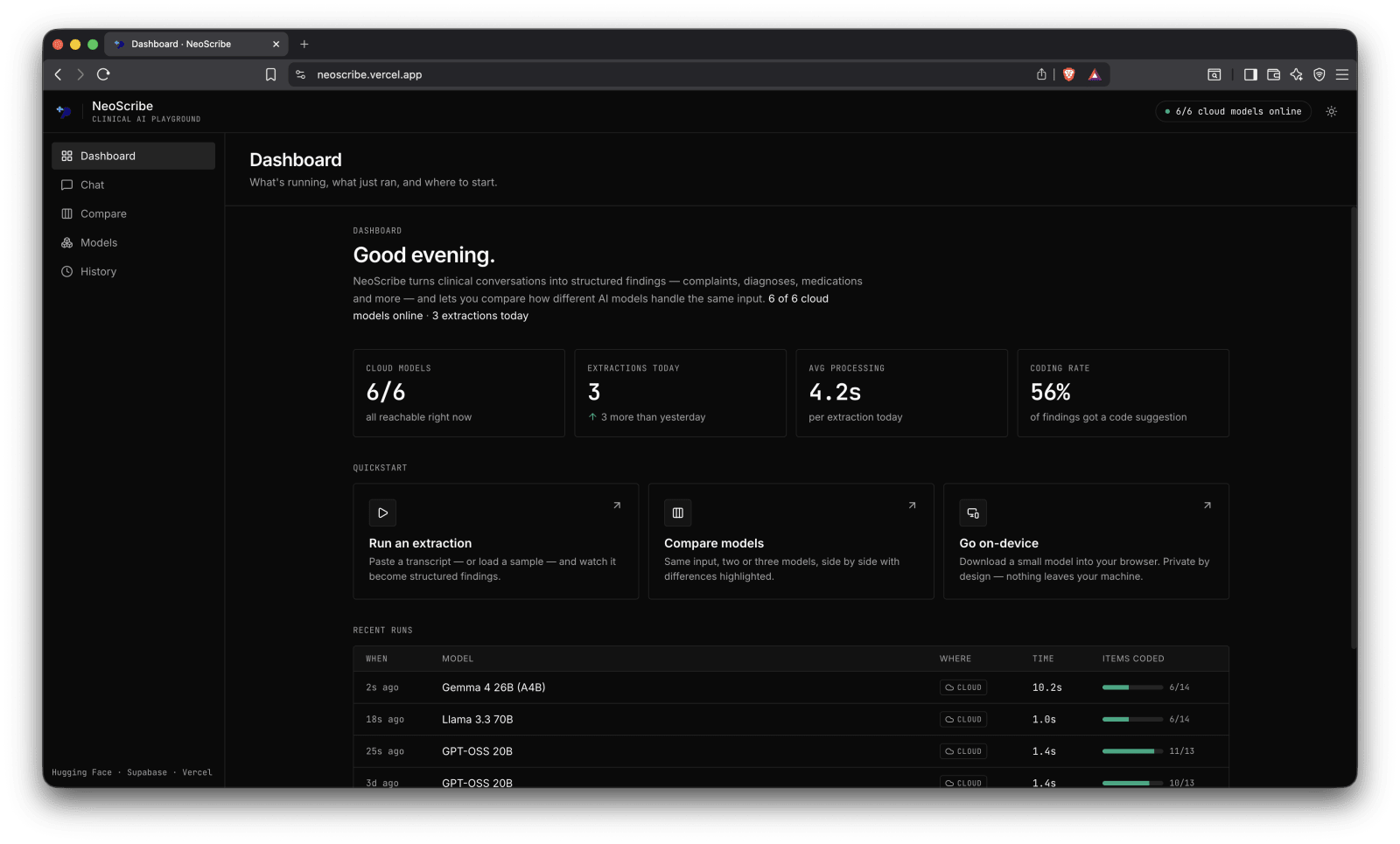
Clinical documentation eats clinician time, and every tool promises an AI that writes the note for you. NeoScribe, built at Plural Health, asks the more useful question first: which model should you trust with that job at all? It is a playground for running a clinical conversation through many models and seeing, side by side, how each one turns it into structured findings and codes.
Approach
Paste a conversation or a note and NeoScribe extracts structured findings, complaints, diagnoses, medications, with suggested ICD-10, SNOMED, and RxNorm codes. Run one model, or line up two or three against the same input with per-finding diffs. Models run one of two ways: hosted in the cloud, or downloaded and run entirely in the browser on WebGPU, down to a 135M model small enough that the transcript never leaves the machine. Before an on-device model downloads, NeoScribe checks the device and gives an honest verdict, good fit, slow, or not recommended, rather than failing halfway through.
Outcome
The honesty is the feature. Suggested codes are the models' own guesses, not checked against a terminology server, and the interface says so wherever they appear. Watching where a 135M model invents a code and a 70B one does not is half the point. It is live and open to try.